

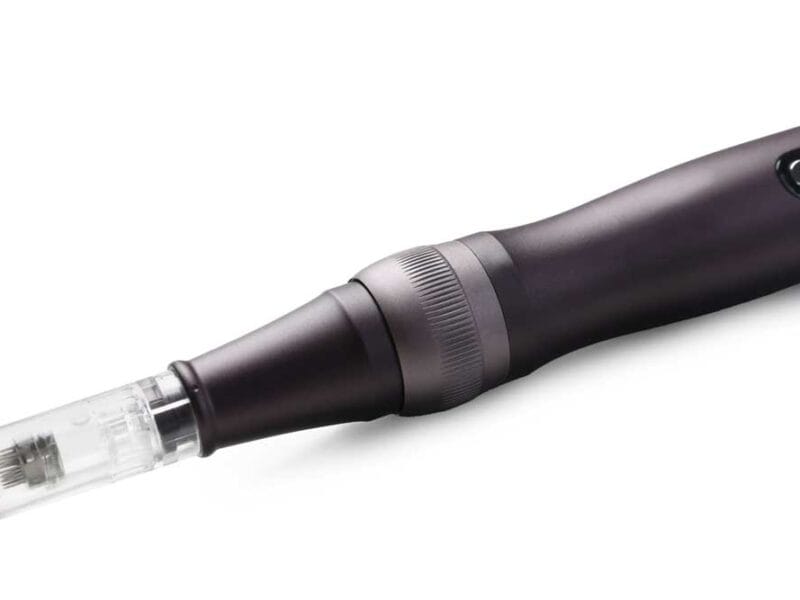
For years, microneedling has been a reliable treatment for softening acne scars, smoothing wrinkles, and fading hyperpigmentation. More recently, it’s also proven to be surprisingly effective on the scalp, where it’s increasingly used to slow hair loss in men and promote thicker, fuller growth.
If you have androgenetic alopecia (A.K.A. male-pattern baldness) and are actively thinning or balding, there are a number of reasons to be optimistic about your chances of holding on to your hair, especially if you’re acting early. Is microneedling one of those reasons? Let’s see how it stacks up against more established treatments.

How does microneedling treat hair loss?
Microneedling is what it sounds like: Tiny, surgical-grade needles create microchannels in the skin or scalp to trigger the body’s natural wound-healing response. (Despite how it sounds, microneedling is a minimally invasive procedure.) This process stimulates elastin and collagen production, which helps to improve the skin’s tone and texture.
Where your hair is concerned, it also drives the release of growth factors and increases blood flow, a process that culminates in the activation of stem cells around the hair follicle. What this does is nudge dormant follicles back into a growth phase and strengthen the ones that are already active.
The micro-injuries also enable topical treatments, such as minoxidil, platelet-rich plasma, and serums, to penetrate more effectively.
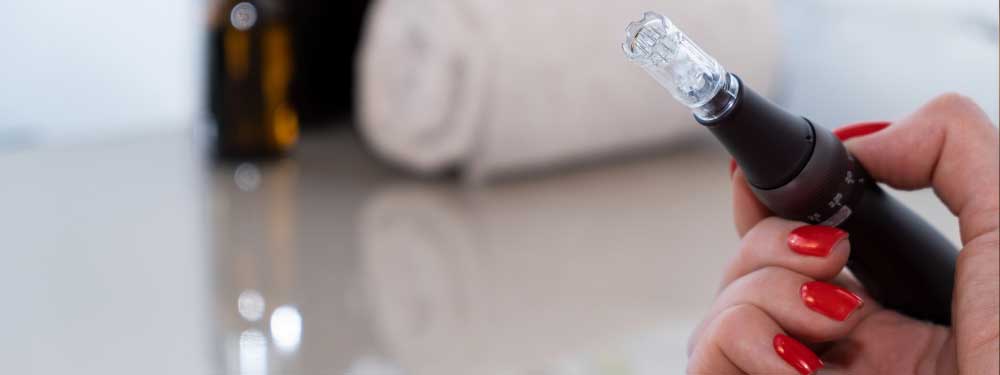
If you’ve never had or seen microneedling done before, you’re probably envisioning a fairly horrifying procedure by now. This is what the treatment actually entails: You sit with a numbing cream on the area that’s going to be treated for about a half-hour. Then, the microneedling device is moved across your scalp. Sometimes, but not always, a topical treatment may follow. You can expect minor swelling, pain, and redness to follow, but it all should be short-lived.
What does the science say?
While there’s ample evidence supporting the effectiveness and safety of microneedling, the research on microneedling for hair loss is limited. One review in the Journal of Cosmetic Dermatology found that microneedling significantly increased total hair count compared to 5% topical minoxidil, and pairing them offered even greater benefit.
This is generally how dermatologists are approaching microneedling as a hair-loss therapy, pairing it with other topical treatments. By targeting hair loss on multiple fronts, they’re observing “modest to meaningful” improvements in fullness, shaft thickness, density, and overall hair health. It also seems to result in less shedding.
That said, microneedling will not halt the underlying genetic process. Medical-grade hair loss therapies like oral Propecia are likely to be more effective. But microneedling can be a valuable supporting player when paired with other oral, topical, or in-office therapies.
Should you try it?
The anecdotal data suggests that microneedling to slow hair loss and promote thicker, fuller hair is worth considering. Just note that you’ll need to commit to a series of treatments. Generally, dermatologists recommend at least three, spaced about a month apart.
For those just beginning their hair restoration journey, microneedling is a low-risk entry point. And for those already undergoing treatment, it can potentially be the missing piece.
 How Your Skincare Habits Might Change in the Year Ahead (Part 2)