


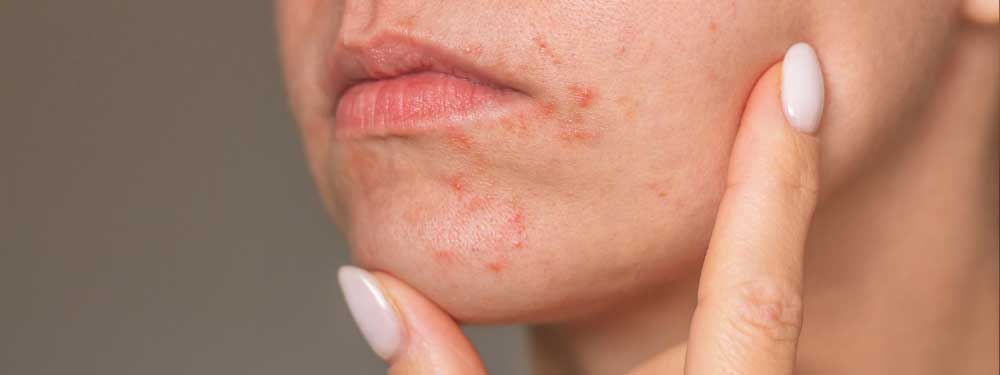
If you frequently get rashes around your mouth or under your nose, it may be perioral dermatitis, which is often confused for eczema and acne.
If this is the first you’re hearing of the condition, here’s what you should know about it: Perioral dermatitis is a facial rash that most commonly appears around the mouth and nose, but it can pop up in other areas too, including the cheeks, chin, and the outer parts of the eyelids. The rash is usually red and bumpy and sometimes itchy and mildly uncomfortable, but not always. And sometimes the bumps are puss-filled.
It’s not clear what causes perioral dermatitis – something you’ve come in contact with may have irritated your skin or you could be allergic to a new ingredient in your skincare routine – but we do know it’s not contagious.
How to treat it at home
We need to cast a big net when considering potential causes for your rash because perioral dermatitis can stem from any change in your environment, and those differences can often be subtle. The rash may also be a reaction to a new skincare product. Even there, the list of potential culprits is extensive: preservatives, dyes, fragrance, active ingredients.
The best strategy, then, is to temporarily pare down your skincare routine to its foundation. For the next few weeks, no topical products with any active ingredients or preservatives, dyes, or fragrances. Instead, use only a gentle, sulfate-free cleanser (with tepid water), a basic moisturizer, and a sunscreen.
When to see a dermatologist
If, after four weeks, this change in routine isn’t having a noticeable effect on your rash, or if your rash has gone away and come back over that time, it’s a good idea to see a board-certified dermatologist, who will make sure that what you’re dealing with is in fact perioral dermatitis.
Assuming it is, they’ll likely prescribe an oral or topical antibiotic, which should provide fast relief. Metrogel and Soolantra, popular medications for rosacea, could help reduce redness and swelling, as well.
If your rash keeps coming back and you don’t know why, the dermatologist may also recommend an allergy patch test to see if they can isolate what could be causing it.
The takeaway: You don’t need to suffer through persistent rashes, especially if they’re itchy or painful. Try going back to the basics. And if that doesn’t work, turn to a dermatologist for help.
 How to Figure Out How Frequently You Need to Shower